
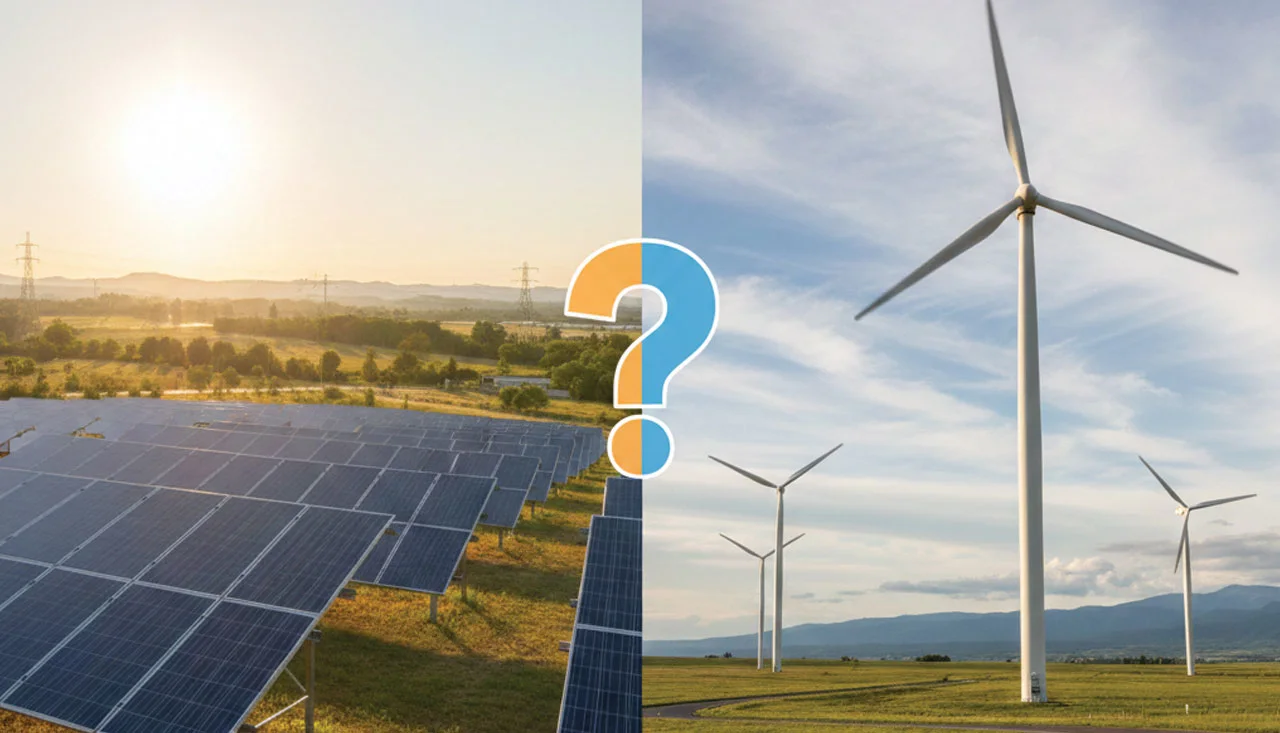
A balanced, non-techy comparison of solar vs wind: costs, reliability, environmental trade-offs, and when to pick which for real projects.
There’s no universal winner. For small, local, fast deployments (rooftops, village electrification, pumps) solar usually wins for cost, simplicity and modularity. For large-scale, bulk clean power where land and grid access allow, onshore wind often delivers more energy per installed MW and lower cost per MWh in many locations. Best practice: use both where possible, and plan storage or demand flexibility to manage variability.
1) Cost: both are cheap
Utility-scale solar PV and onshore wind have both seen steep cost declines; today they are among the cheapest ways to generate electricity in many markets. Levelized cost studies (Lazard, etc.) show utility solar and onshore wind competing closely, sometimes one is cheaper than the other depending on the country, financing, and project scale. Also remember to account for the cost of firming (batteries, peaker plants, transmission) to make intermittent power reliable.
What that means for you: for a village water scheme or rooftop power for a school, solar will usually need less capital coordination and give predictable returns. For bulk power for an industrial park or an offtake contract, wind can be more cost-effective where wind resources are strong.
2) How much energy you actually get
Solar panels produce during daylight; capacity factors (actual energy produced divided by theoretical max) are commonly 10–25% depending on location and whether it’s rooftop or utility scale. Onshore wind capacity factors are often higher commonly 25–45% for good sites and offshore wind can be much higher still. That means a 1 MW wind farm often produces more annual energy than a 1 MW solar farm in the same region.
Practical takeaway: compare expected annual MWh, not just rated MW. A higher capacity factor reduces land cost per MWh and makes firm contracts easier.
3) Land use and siting
Solar and wind differ in how they use land. Solar arrays (especially utility ground-mounted farms) concentrate infrastructure and require contiguous land, but panels can also be sited on rooftops or over canals enabling dual use. Wind turbines have a small physical footprint but require large spacing; that spacing can often remain agricultural or grazing land. Studies show large variability in reported land-use metrics, so local assessment is crucial.
For rural projects: rooftop solar or small community solar on marginal land is usually easiest. Wind can work where farms have steady winds and where community acceptance and access are good.
4) Environmental trade-offs
Both technologies emit a tiny fraction of the greenhouse gases of fossil fuels across their lifecycles. Differences arise in material use (steel and composites for turbines; silicon, metals and glass for PV), local impacts on biodiversity, and end-of-life recycling. Good siting and de-risking (bird/bat studies for wind, recycling plans for PV) reduce impacts.
5) Reliability & integration
Neither solar nor wind is dispatchable on demand. Both become far more valuable when paired with:
- Storage (batteries) for short-term
- Diversification (wind often blows at night; solar generates by day).
- Demand flexibility (shift pumps or industrial loads to match output).
System costs for firming are real, Lazard and other analyses stress adding these when comparing “real” cost to grid operators.
6) When to pick solar
- You need quick, modular capacity (rooftops, schools, clinics).
- Grid-connection is difficult or
- You want lower O&M and simple
- Budget is constrained and you prefer staged
Solar wins for decentralised water pumps, community electrification, and buildings.
7) When to pick wind
- You’re planning large, utility-scale generation and have good wind resource
- Land availability is large and community/landowner agreements are
- You seek higher annual energy yield per MW and stronger long-term capacity
- Offshore options exist (higher yields but higher capex).
Wind is often better for regional power supply or industrial clusters where land is available and transmission can be arranged.
8) Hybrid wins
A hybrid park (wind + solar + storage) smooths output across day/night and weather, reducing the required storage and improving grid value. For CSR or large rural electrification programs, mixing rooftop solar, a nearby small wind farm (if wind resource supports it), and targeted storage delivers resilience and better utilization.
- Is the goal local supply (school, pumps)? → Solar (+battery).
- Is the goal bulk power for many users/industries? → Check wind resource; if high, wind likely
- Want reliability and best value? → Combine wind + solar + storage where
Solar and wind are both essential tools to decarbonise power. For on-the-ground rural projects and quick wins, solar is usually the practical choice. For large, utility-scale clean energy, wind often produces more energy per MW and can be more economical in good sites. The smartest projects treat the choice as technical and local: measure the resource, model the energy (MWh), plan for storage, and design community governance and maintenance.